This guide walks you through your first session with Framework — from uploading a document to getting your first AI-powered answer with citations. The whole process takes about 5 minutes.
Prerequisites: You’ve already created your account and are logged into your project workspace.
Step 1: Upload a Document
Start by uploading a project document. Framework works with PDF files — specifications, drawings, RFIs, submittals, and any other construction documents.
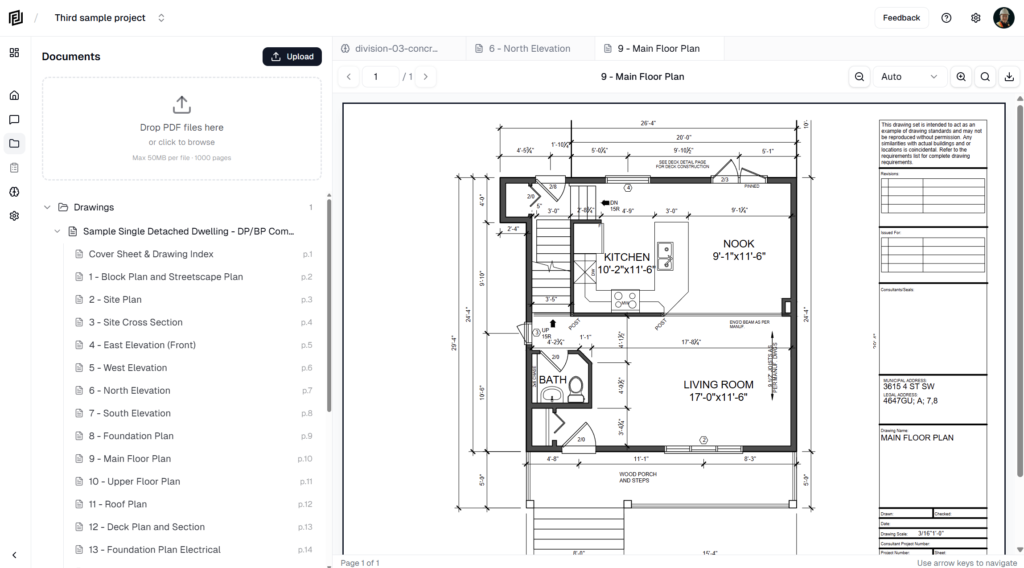
- Click the Documents icon in the activity bar on the left side of the screen (it looks like a folder).
- The Documents sidebar will open, showing an upload zone at the top.
- Drag and drop a PDF file into the upload zone, or click “click to browse” to select a file from your computer.
Once you drop a file, it appears in the upload queue with a blue highlight showing it’s ready to upload.
- Click Start Upload to begin processing.
What happens during upload
After you click Start Upload, Framework processes your document through several stages:
- Uploading — The file is uploaded to secure cloud storage.
- Compressing — The PDF is optimized for AI processing.
- Analyzing — AI reads the document, identifies sections, and extracts key information.
- Indexing — Searchable sections are created so the AI can find information quickly.
A progress bar shows the current stage, along with a time estimate. Most documents process in 3–8 minutes depending on size. You can navigate away while processing — Framework will continue in the background.
When processing is complete, the file appears in your document tree, automatically categorized by type (specifications, drawings, etc.).
Tip: You can upload multiple files at once. Just drag and drop several PDFs into the upload zone.
Step 2: Start a Conversation
Now that you have a document uploaded, it’s time to ask your first question.
- Click the Chat icon in the activity bar (it looks like a message bubble).
- The Chat sidebar opens, showing your conversation list.
- Click the New Conversation button (or the + icon) to start a fresh conversation.
A new conversation tab opens in the main area with a message input at the bottom.
Step 3: Ask a Question
Type a question about your document in the message input. Use plain English — you don’t need special syntax or keywords.
Example questions:
- “What is the concrete strength for foundations?”
- “What type of roofing membrane is specified?”
- “Summarize the structural steel requirements”
- “What are the fire rating requirements for the stairwells?”
- “List the paint specifications for interior walls”
Type your question and press Enter (or click the send button) to submit it.
Step 4: Watch the AI Work
After you send your question, Framework shows you exactly what’s happening in real time. This is one of Framework’s key features — full transparency into the AI’s process.
You’ll see the AI go through several steps:
- Thinking — The AI considers your question and plans its approach. You can expand this to see the AI’s reasoning.
- Searching documents — The AI searches across your uploaded documents for relevant content. You’ll see which documents it’s looking through.
- Reading sections — Once it finds relevant sections, the AI reads the actual document content to extract the precise information you need.
- Composing answer — The AI formulates its response with specific citations to the source material.
This entire process typically takes 10–30 seconds depending on the complexity of your question and the number of documents.
Step 5: Read the Response
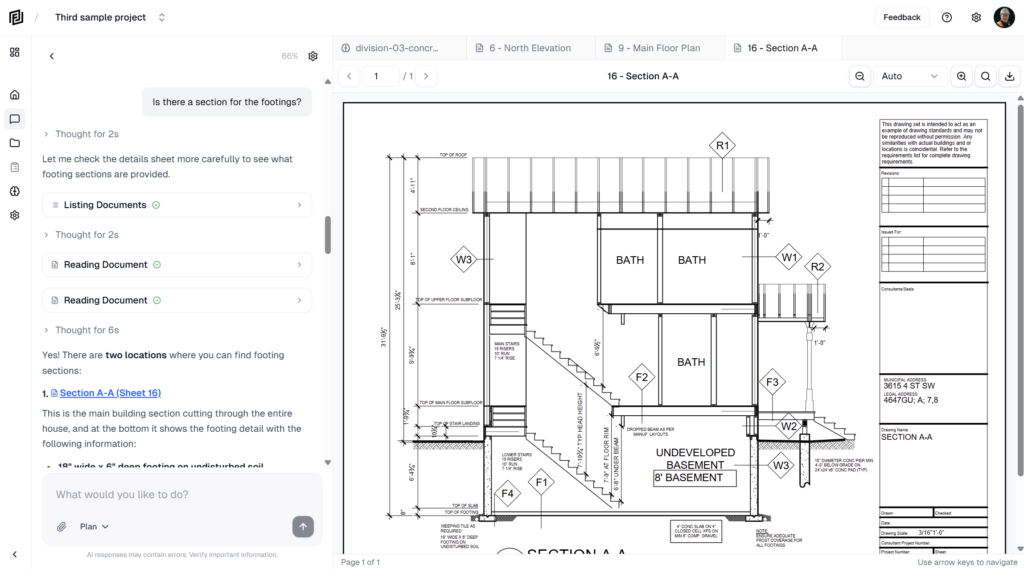
The AI’s response appears in the chat with your answer and citations — references to the exact location in your documents where the information was found.
Citations appear as clickable references within the text. Each citation points to a specific document and page number.
Step 6: Verify with Citations
The power of Framework is that you never have to take the AI’s word for it. Click any citation in the response to open the source document directly to the referenced page.
The document opens in a new tab in the main viewport, scrolled to the exact page referenced. You can read the original text yourself to verify the AI’s answer.
Tip: You can keep the document tab open and switch between the chat and document tabs to cross-reference information as you go.
Step 7: Keep Asking
Continue the conversation by asking follow-up questions. The AI remembers the context of your conversation, so you can drill deeper into topics:
- “What about the reinforcement requirements for that section?”
- “Are there any exceptions to that specification?”
- “What does the drawing show for that detail?”
You can ask as many questions as you like within the same conversation. When you want to change topics entirely, start a new conversation to keep things organized.
What’s Next?
You’ve completed the core Framework workflow. Here are some next steps to explore:
- Upload more documents — The more documents you upload, the more comprehensive the AI’s answers become.
- Learn the workspace — Understand the full interface including the activity bar, sidebars, and tab system.
- Explore Plan & Act modes — Learn how to control the AI’s approach to answering your questions.
- Tips for better results — Learn how to write questions that get the most accurate answers.
- Create another project — Set up projects for each of your construction projects to keep documents organized.