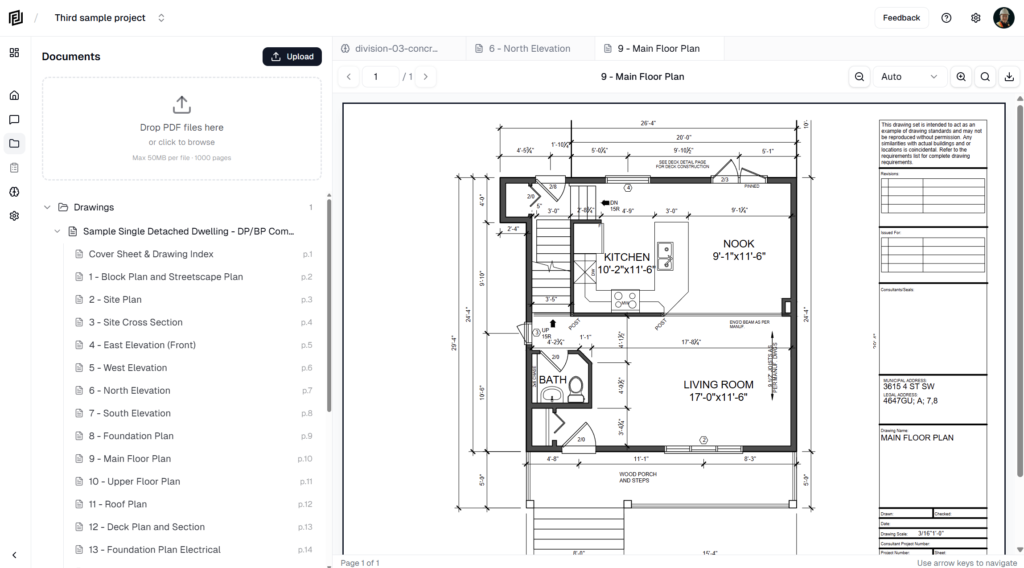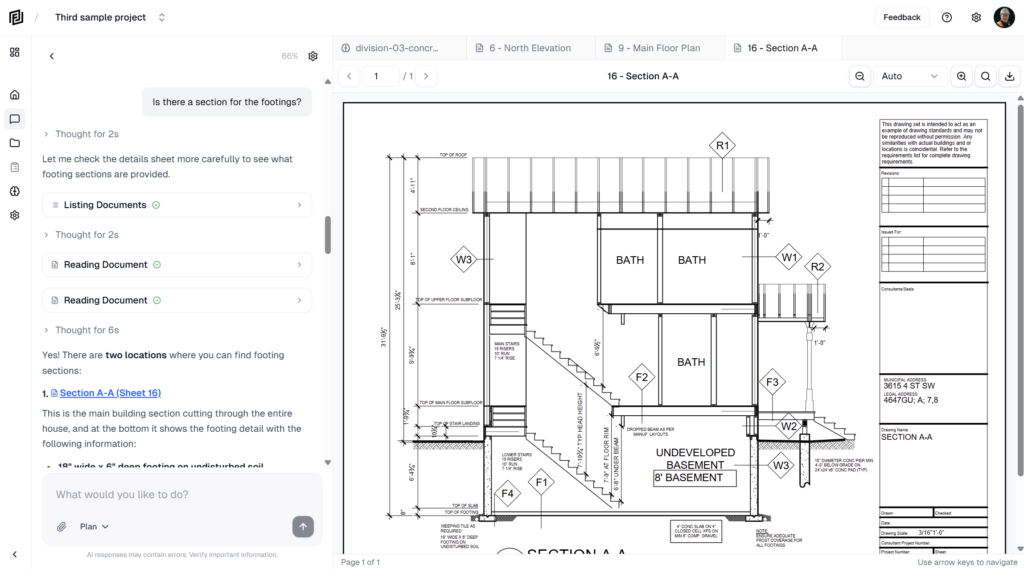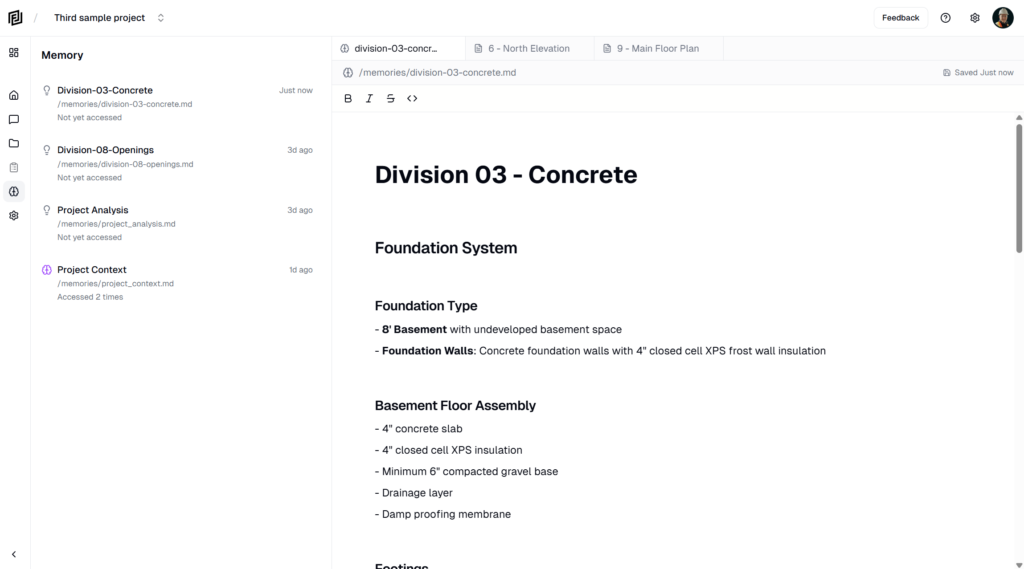
Open the Memory sidebar by clicking the brain icon in the activity bar. The sidebar lists all memory files for your current project.
Each memory entry displays:
- Icon — Purple brain icon for context files, lightbulb for other memory types
- Title — A human-readable name derived from the file path
- Time stamp — How recently the file was updated (e.g., “2h ago”, “3d ago”)
- File path — The actual path within the memory bank
- Access count — How many times the AI has referenced this memory
Opening a Memory File
Click any memory file in the sidebar to open it in the main viewport. The file opens in a new tab, just like documents or notes.
When a memory file is open, you’ll see:
- A rich text editor — The memory content displayed in a clean, readable format
- The tab label — Shows the memory file name at the top of the workspace
- Active highlighting — The corresponding sidebar item is highlighted
Editing Memory Files
Memory files are fully editable. You can correct, add to, or rewrite any content the AI has stored.
Why Edit Memory?
- Correct inaccuracies — Fix anything the AI got wrong about your project
- Add missing context — Include details the AI hasn’t captured yet
- Remove outdated info — Delete context that’s no longer relevant
- Guide AI behavior — Add preferences for how the AI should respond
How to Edit
- Open the memory file by clicking it in the sidebar
- Click into the editor area in the main viewport
- Make your changes — the editor supports rich text formatting
- Changes save automatically — no save button needed
Auto-save: Your edits are saved automatically as you type. There’s no risk of losing changes.
Memory File Actions
Hover over any memory file in the sidebar to reveal a three-dot menu (⋮) with the following options:
| Action | Description |
|---|---|
| Open | Opens the memory file in the main viewport editor |
| Delete | Permanently removes the memory file (with confirmation) |
Deleting Memory Files
To delete a memory file:
- Hover over the memory file in the sidebar
- Click the three-dot menu (⋮) that appears
- Select Delete
- Confirm the deletion in the dialog
Warning: Deleting a memory file is permanent and cannot be undone. The AI will no longer have access to the information stored in that file. However, the AI may recreate similar memory files during future conversations if the context comes up again.
When There Are No Memories
If a project has no memory files yet, the sidebar displays an empty state with the message:
No memories yet
The AI will create memories as you chat about your project.
To start building memory, simply begin having conversations with the AI about your project. As you discuss project details, share preferences, and ask questions, the AI will automatically create memory files to store important context.
Best Practices
- Review periodically — Check your memory files occasionally to ensure accuracy
- Correct early — If you notice an error, fix it right away so future conversations don’t build on wrong information
- Don’t delete important context — If unsure about a memory file, edit it rather than deleting it
- Let the AI build memory naturally — You don’t need to manually create memory files; the AI handles this through your conversations
← What is Memory?
Notes →