Key Concept: Memory is the AI’s long-term knowledge about your project. As you chat, the AI creates and updates memory files that help it provide more relevant, context-aware answers over time.
How Memory Works
Every project in Framework has its own memory bank — a collection of files that store important context about your project. Think of it as the AI’s notebook where it records key details, decisions, and patterns it learns from your conversations.
The Memory Lifecycle
- You chat with the AI — Ask questions, discuss your project, make decisions
- The AI identifies important context — Key details, preferences, project specifics
- Memory files are created or updated — The AI stores this knowledge for future reference
- Future conversations benefit — The AI references memories to provide more accurate, personalized responses
What Gets Stored in Memory
Memory files typically contain:
| Type | Examples |
|---|---|
| Project Context | Project type, scope, key stakeholders, timeline |
| Decisions | Design choices, material selections, change orders discussed |
| Preferences | How you like responses formatted, areas of focus |
| Key Findings | Important spec requirements, critical dates, budget details |
| Relationships | Connections between documents, cross-references, dependencies |
Memory vs. Notes
Framework provides two distinct features for storing information:
| Memory | Notes | |
|---|---|---|
| Created by | The AI (automatically) | You or the AI |
| Purpose | AI’s project knowledge | Your personal workspace notes |
| Editable | Yes — you can view and edit | Yes — full rich text editing |
| AI reads them | Yes — automatically during chat | Yes — when using tools |
| Organization | Flat file list | Tags, date grouping |
Accessing Memory
To view your project’s memories:
- Click the Memory icon (brain icon) in the activity bar on the left side of the workspace
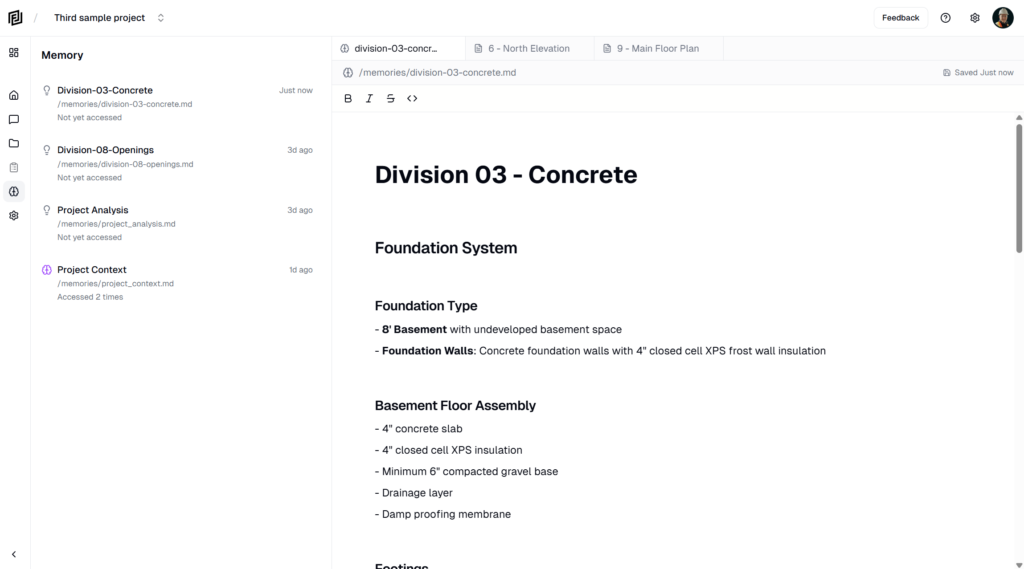
- The sidebar will display all memory files for the current project
- Click any memory file to open it in the main viewport
📸 Screenshot: Memory sidebar showing memory files list
Memory File Details
Each memory file in the sidebar shows:
- File name — A descriptive title derived from the file path
- File path — The location within the memory bank (e.g.,
memory-bank/context.md) - Last updated — When the file was last modified
- Access count — How many times the AI has referenced this file
Privacy: Memory files are project-specific and private to your account. They are not shared between projects or with other team members. You have full control — you can view, edit, or delete any memory file at any time.
How Memory Improves Over Time
The more you interact with the AI on a project, the better its memory becomes:
- Early conversations — The AI starts with just your uploaded documents
- After a few chats — Memory files begin capturing project context and your preferences
- Ongoing use — The AI builds a comprehensive understanding of your project, leading to faster, more accurate responses
← Tips for Better Results Managing Memory Files →Tip: If the AI gets something wrong in a memory file, you can open and edit it directly. The AI will use your corrected version in future conversations.